
Why poor contact still occurs despite meeting all parameters?
In industrial automation, humanoid robots, rail transit, 5G base stations and new energy equipment projects, many engineers have encountered such a puzzle: the purchased circular connectors fully meet the drawing standards in electrical parameters, protection level and overall dimensions , and all perform well in static laboratory tests. However, once installed and put into actual working conditions, intermittent signal interruption, unstable power transmission and frequent poor contact faults often occur, resulting in production line downtime, equipment rework and increased later maintenance costs.
Why do products with perfectly matched parameters still malfunction after installation? The problem rarely lies in the parameters themselves, but in four easily overlooked dimensions: working condition adaptation, structural design, process quality control and supporting matching.
I. Core Analysis: 4 Root Causes of Poor Contact Despite Standard Parameters
1. Static Parameters ≠ Actual Industrial Working Conditions
Most connector parameters are tested only in a normal temperature, static and interference-free laboratory environment. Industrial sites are generally faced with continuous vibration, alternating high and low temperatures, dust, humidity and electromagnetic interference. Even if ordinary connectors meet IP and electrical parameters, they lack industrial-grade adaptability for vibration resistance, temperature resistance and electromagnetic shielding. Long-term operation will lead to loose contacts and metal oxidation, inevitably causing poor contact.
2. Defective Structural Design Hidden Connection Risks
Some manufacturers only copy basic appearance parameters while ignoring key details of keying design, locking structure and sealing architecture . Without accurate keying coding, assembly misalignment easily causes virtual connection; insufficient buckle locking force leads to slight displacement of plugs and sockets under equipment vibration; simple sealing structure allows water vapor and dust to invade contacts, accelerating corrosion and failure.
3. Insufficient Mass Production Precision & Inconsistent Quality Control
Many manufacturers only conduct sampling parameter tests, ignoring the precision of terminal stamping, shell injection molding and contact assembly in mass production. Even if sampling parameters are up to standard, batch products are prone to concentricity deviation, contact elasticity attenuation and uneven internal gaps, resulting in immediate contact faults after installation and stress, due to the lack of full-process precision quality inspection system.
4. Mismatch Between Connectors and Harness Assembly
Many projects purchase connectors separately and match them with ordinary wire harness crimping at will. Mismatched crimping process and wire gauge deviation will cause loose connection between cables and terminals. Although the connector parameters seem normal, the loopholes in harness assembly will gradually evolve into poor contact under equipment movement and vibration.
II. Practical Guide: Avoid Poor Contact From Selection to Installation
- Beyond Paper Parameters, Prioritize Working Condition Adaptation : Do not only focus on voltage, current and IP rating. Focus on vibration resistance, high and low temperature resistance and electromagnetic shielding performance to match long-term operation requirements of industrial robots, outdoor base stations and vehicle-mounted equipment.
- Choose Products With Industrial Keying & Locking Structure : Select circular connectors with multi-specification keying coding, precision buckle locking and integrated sealing design to avoid assembly misalignment, plug loosening and environmental erosion from the structural level.
- Choose Products With Authorized Certification & Full-Process QC : Prioritize manufacturers with CE, FCC international certifications and strict IP67 protection standards, implementing precision testing from R&D and production to finished products to ensure consistent batch quality.
- Adopt One-stop Solution of Connector + Custom Harness : Abandon scattered procurement. Choose suppliers providing integrated solutions of connectors, cables and harness assemblies, with original factory matched crimping technology and assembly standards to avoid adaptation loopholes from the source.
III. Professional Solution: Octopusconn Solves Industrial Poor Contact Problems
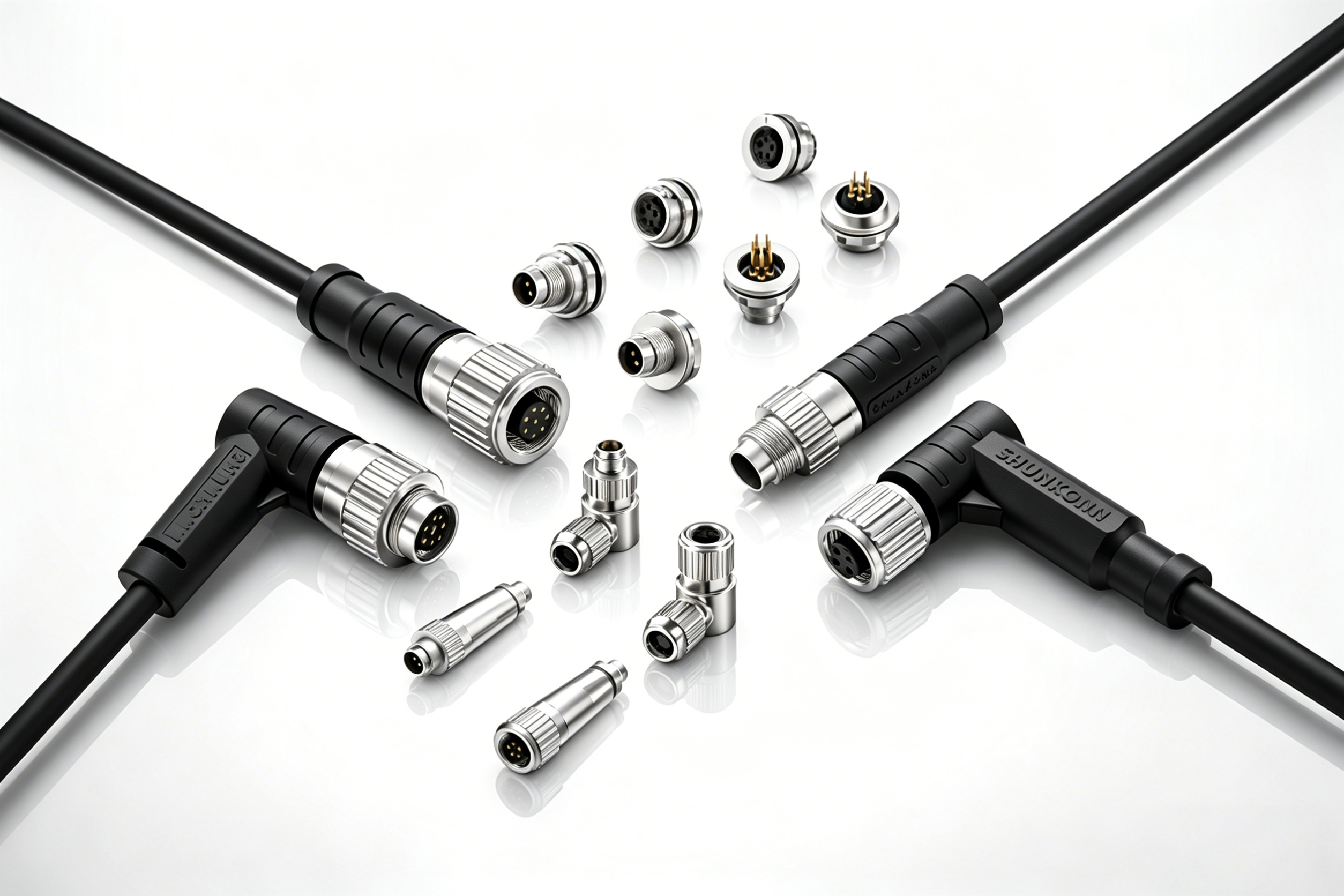
As a professional R&D and manufacturer of industrial circular connectors with years of experience, Octopusconn focuses on the demands of harsh industrial scenarios. We target the industry pain point of frequent poor contact after installation through optimized product design, strict process control and professional supporting services:
- Full-range Working Condition Product Matrix : Covers mainstream industrial circular connectors such as M5, M8, M9, M12, M16 and 7/8, built for vibration resistance, temperature resistance and high shielding. The M12 series supports A/D coding keying design, perfectly compatible with PROFINET, EtherCAT and other industrial Ethernet systems.
- Precision Structural Design for Higher Connection Stability : Product categories include overmolded plugs, field assembly plugs, sockets and harness assemblies. Reinforced locking structure and IP67 dustproof & waterproof sealing effectively resist dust and water vapor erosion on site.
- Strict Quality Control & Authorized Qualification : Established full-process quality management system with precision inspection in every process. All series pass CE and FCC certifications and comply with EN60529 international standards, ensuring high consistency of batch products.
- One-stop Custom Service for Equipment Integration : Capable of prototype R&D and mass delivery, providing integrated solutions of connectors, cables and custom harnesses to completely solve the mismatch between connectors and harness assembly.
IV. Summary
For industrial connector selection, standard parameters are only the basic threshold. Working condition adaptation, structural design, process consistency and supporting services are the core essentials . Simply purchasing according to parameter sheets cannot cope with complex industrial working conditions, leading to inevitable poor contact and equipment downtime.
Adhering to the core concept of "Precise Connection, Stable Performance", Octopusconn focuses on R&D and customization of industrial-grade circular connectors, providing high-stability connection solutions for industrial automation, rail transit, medical equipment, new energy and other industries. If you have confusion in connector selection, troubleshooting of installation contact faults or customized connection demands, feel free to contact our professional technical team to build a solid connection foundation for your equipment.
Official Website: https://www.octopusconn.cn/
Tel: +86 18925497513
 telephone
 Contact US