
How to Address Salt‑Fog Corrosion in Offshore Wind Power?
The service boat pulls alongside the tower and steadies. The technician opens the hub connector and frowns: "The housing is whitened with rust, the contacts look dull — this joint can't take the sea wind." What offshore wind fears most is rarely the storm itself, but salt mist slowly eating into the metal seams.
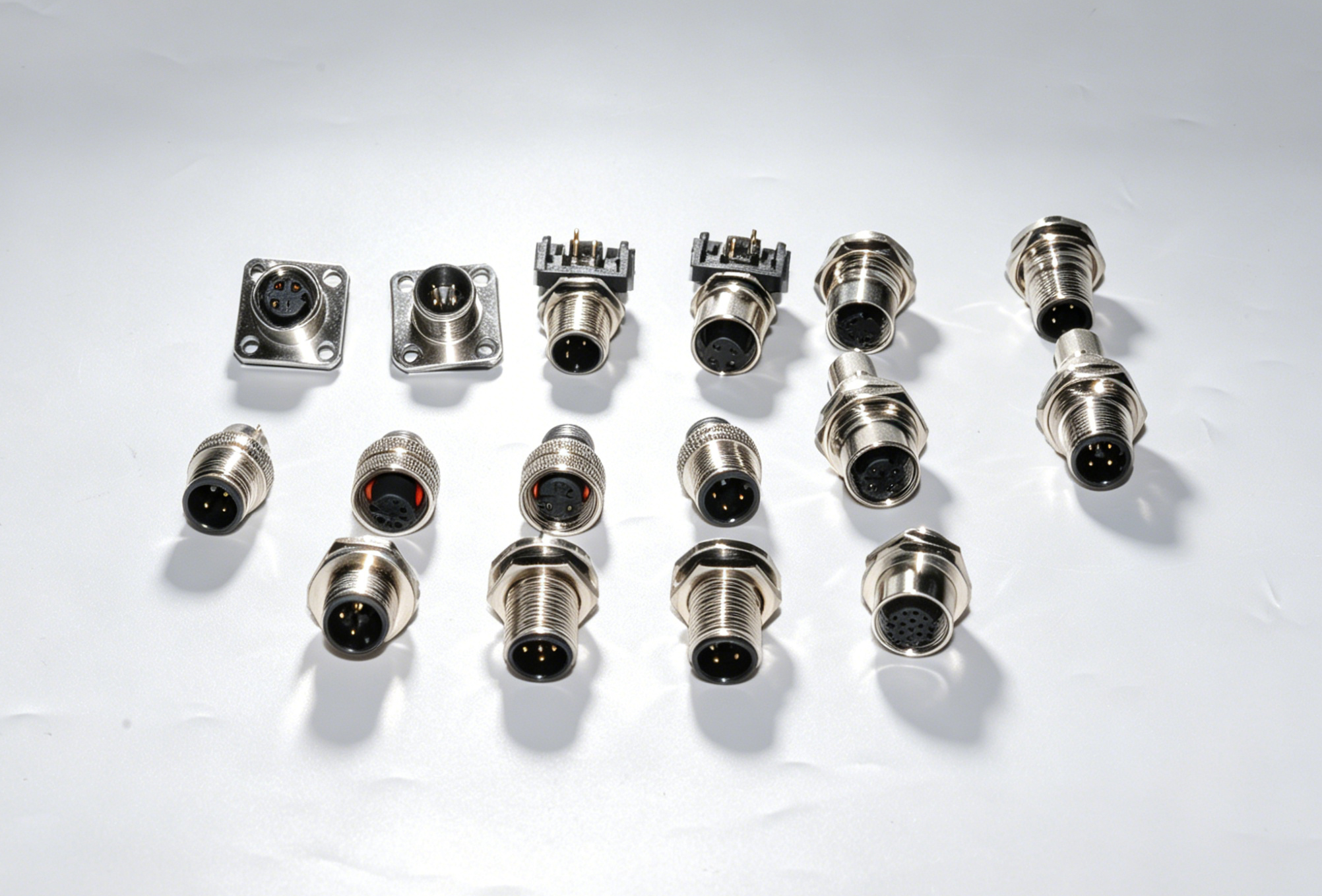
Why salt mist is the "invisible killer" of connectors
Offshore environments are high in salt, high in humidity, and swing widely in day-night temperature. Salt mist forms an electrolyte film on metal surfaces, triggering electrochemical corrosion: housing rust, contact oxidation, seal aging. The outward signs are rising contact resistance and signal bit errors, until complete failure. And the spots that suffer the environment most — nacelle, hub, pitch — are exactly where connectors are packed.
Six questions you must nail down for selection
01 What should you guard against first offshore?
Corrosion starts from the housing. Octopus M16 uses nickel-plated brass or zinc-alloy die-cast housing — compressive, wear-resistant, anti-corrosion, oil-resistant, UV-resistant. M12 uses nickel-plated brass full-metal housing, corrosion- and heat-resistant (wide temp -40°C~+85°C). The dense, uniform nickel layer is armor that blocks salt mist from the base metal.
02 The housing looks fine — will the inside rust?
Contacts must hold too. Octopus contacts use copper with gold plating — gold is chemically stable and resists oxidation and sulfidation in humidity, salt mist and corrosive gas, keeping contact resistance low and stable long-term, so offshore maintenance-free stays reliable.
03 Spray and moisture — how to keep water out?
IP67 is the offshore starting line. The full range reaches IP67 (30 min immersion at 1 m without ingress), paired with 360° EMI/RFI shielding and silicone seals to physically block salt mist, water and dust; it also resists EMI — salt-mist condensation often brings electro-corrosion and interference, so shielding is not optional.
04 Short offshore replacement window — what if it's plugged wrong?
Coding prevents mis-mating. Octopus M12 follows EN/IEC 61076-2-101 with full A/B/D/K/S/T/X coding: A-coded for sensors like temp/humidity/pressure (incl. PV & wind outdoor equipment); D-coded for PROFINET/EtherCAT industrial Ethernet (common in harsh duty like petrochem, power); X-coded 8-pin Cat6A, 10Gbps, for high-speed data aggregation. Coding is the "wrong-plug-proof ID".
05 Everyone claims weatherproof — what proves it?
Look at the salt-mist test. Octopus' full circular connector range targets 1000 hours salt-mist resistance as the baseline design goal, and runs graded testing per ANSI/EIA-364-26C: general industrial 48h, coastal 96h, marine grade 500–1000h, passing at corrosion grade 0–1. When selecting, ask one question first: "How many hours of salt-mist testing?"
06 If replacement is needed, will it stop operation long?
Pre-molded cable assemblies are plug-and-play, modular for quick swap, shortening the offshore downtime window; M16 mating life exceeds 500 cycles, maintenance-free long-term. With CE/FCC/RoHS certification and full-process precision QC, compatibility, quality and maintenance are all covered.

 telephone
 Contact US