Late last year, a customer building PV inverters ran the numbers for us: the imported M12 D-coded connector they had been using went from ¥18 to ¥27 a piece, and lead time stretched from 3 weeks to 11. One unit takes 12 of them; a 500-unit batch is 6,000 connectors. That single line item added tens of thousands to the BOM, and the line sat idle 9 days waiting on parts.
Not an isolated case. Industrial circular connector import prices have been climbing these past two years, and plenty of equipment makers are stuck on this one line in their bill of materials.
30–50%
Recent import price increase
40%
Single-batch cost cut · comparable domestic substitution
01 · WHERE THE IMPORT PREMIUM GOES
Let's be clear: a big part of that 30–50% rise is "distribution cost," not the product being worth more. Break an import purchase down and the price stacks at least these layers:
Tariffs and import duties
Industrial connectors brought in carry a real tax load that goes straight into the unit price.
Exchange rate swings
Settled in EUR or USD, a few points of movement over half a year eats into margin.
Ocean freight + multi-tier distributor markup
From factory to your dock it passes several hands, each adding a bit; the price you pay is long past ex-works.
Capital tied up by long lead times
An 11-week lead time means pre-stocking, holding inventory, tying up cash flow—often a harsher hidden cost than the unit price.
Domestic substitution saves exactly these distribution layers: no import duty, no ocean freight, no multi-tier markup, and lead time shifts from "months" to "weeks." Under most standard procurement structures, taking ~40% off total single-batch cost is achievable.
02 · DOMESTIC SUBSTITUTION, THREE FEARS ANSWERED
Price can come down, but the first reaction isn't "switch," it's "dare I switch." The three most-asked questions, answered with real specs.
Compatible? — Built to international standards, not "looks like it'll fit"
Take M12: strictly follows EN/IEC 61076-2-101 with full A/B/D/K/S/T/X coding. D coding maps to PROFINET and EtherCAT; pin definitions and interface dimensions follow the international standard, so existing equipment interfaces line up directly.
Quality stable? — Protection, shielding, and temperature range all have hard specs
M12 carries IP67 protection and 360° EMI/RFI shielding; M16 uses nickel-plated brass / zinc alloy housing, wide temp -40℃ to +85℃, contact resistance ≤5mΩ, mating life over 500 cycles. Handles outdoor washdown, oil, and vibration.
Will switching stop the line? — Pre-molded plug-and-play, existing line untouched
Pre-molded cable assemblies plug in and work; field-attachable versions cover solder, crimp, and screw-terminal wiring. You're swapping a part on the existing structure, not re-wiring.
03 · EXAMPLE: OCTOPUSCONN CIRCULAR CONNECTORS
Octopusconn focuses on industrial circular connectors, with full M5 / M8 / M9 / M12 / M16 / M7-8 coverage. Product forms include pre-molded plugs, field-attachable plugs, receptacles, and cable assemblies. Two most-asked series in plain terms:
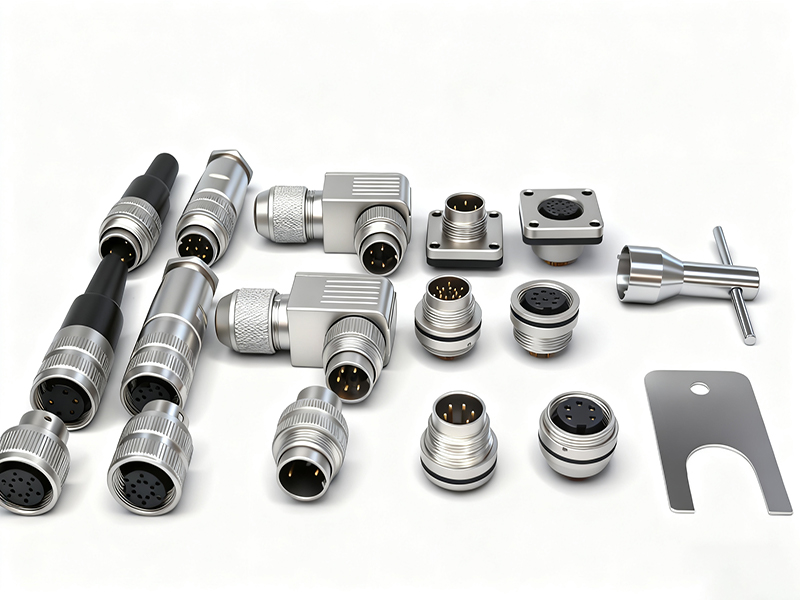
M12 Series · Industrial Ethernet and sensors
12mm thread, 2–12 pins. D coding runs PROFINET / EtherCAT (100Mbps), X coding runs 10Gbps (Cat6A, PoE); A coding 1Gbps for temp / humidity / pressure sensors. In plain terms: full coding = misinsert alarm, won't burn the device; 10Gbps = Industrial 4.0 data flow without bottleneck.
M16 Series · Power and signal heavy-duty
16mm thread, 2–24 pins. IP67 protection, current up to 7A, wide temp -40~+85℃. Suited to PV inverters, servo motors, outdoor surveillance—equipment that needs both power and field ruggedness. In plain terms: IP67 = washdown / outdoor without downtime; nickel-plated brass / zinc alloy housing = holds up in oil and vibration.
Products pass CE, FCC, RoHS export compliance and meet the EN/IEC 61076 series standards—not a "cheap knockoff" with nothing behind it.
04 · ROLL OUT IN THREE STEPS, CHANGE ONE SLICE AT A TIME
Want to switch but afraid of the mess? Don't cut the whole batch at once. Follow this pace; every step is reversible:
Step 1 · Copy the part number you use now
Snap a photo of the import model, or send the part number. We'll match specs against the standard first—same interface, same coding?
Step 2 · Request a sample set to test
We'll ship a few to your line. Plug in, run a signal and protection round. Feel, lock, shielding—match or not, one test tells you.
Step 3 · Small batch of 200 to run a round
If all good, cut the full batch. Even if a model doesn't fit, you've only touched a small slice—main line delivery stays intact.
Have an import part number? Snap a photo and send it over
We'll match the specs against the standard—see if it's the same interface for a direct swap, or needs a tweak. Whether to rescue or replace, you'll know once we've checked.

 telephone
 Contact US